

Table of contents
User experience (UX) design is more than just functionality; it’s about creating a connection between users and digital platforms. Emotional peaks, defined as moments of intense emotional engagement, are crucial in ensuring that users not only interact with a website but also remember and revisit it. These emotional highs often occur when users encounter an unexpected delight, such as a smooth interaction, an engaging visual, or a personalised touch.
Scientific research underscores the importance of these moments. Nobel Prize-winning psychologist Daniel Kahneman introduced the “Peak-End Rule,” which explains that people judge an experience based on its most intense point (the peak) and its conclusion.
Why emotional engagement is key to memorable website journeys
Emotionally engaged users are more likely to stay longer on a website, explore its offerings, and convert into customers. A study by Forrester Research found that brands excelling in emotional engagement have customers who are 3.5 times more likely to recommend their services. In UX design, emotions can drive decisions. For instance, feelings of joy or delight upon using a product can lead to higher satisfaction, while frustration can prompt users to abandon a website entirely.
Memorable website journeys hinge on evoking positive emotions at critical touchpoints. This goes beyond aesthetics; it involves understanding user needs, addressing pain points, and incorporating elements that resonate deeply with the audience. Whether it’s through humour, empathy, or surprise, designers who prioritise emotional engagement create digital experiences that leave a lasting impression.
How emotions influence user decision-making
Emotions play a pivotal role in how users interact with digital interfaces and make decisions. Contrary to the common belief that decision-making is a logical process, neuroscience reveals that emotions are central to this process. Antonio Damasio, a renowned neuroscientist, demonstrated that individuals with impaired emotional responses struggle to make decisions effectively, underscoring the critical role emotions play in navigating choices.
In digital environments, emotions influence everything from the way users perceive a website's credibility to whether they complete a desired action, such as making a purchase. A positive emotional response can lead to trust, while negative emotions like frustration or confusion can result in high bounce rates. For instance, intuitive navigation and clear calls-to-action reduce cognitive load, allowing users to focus on the task at hand with confidence. These emotional cues often work on a subconscious level, making them powerful tools in crafting effective user experiences.
Cognitive biases and their role in creating emotional highs
Cognitive biases, which are systematic patterns of deviation from rationality, also impact how users interact with digital platforms.
One such bias is the "halo effect," where users judge a website positively if its initial impression—often driven by aesthetics—is strong. A beautifully designed landing page can set the tone for trust and engagement. Similarly, the "endowment effect" can be leveraged by offering users a sense of ownership early in the interaction, such as customisation options or trial features that feel personalised.
Another critical bias is "loss aversion," where the fear of missing out (FOMO) drives users to act urgently. Designers can create emotional highs by using urgency cues, such as limited-time offers or countdown timers, to evoke excitement and prompt decision-making.
Identifying emotional touchpoints in the user journey
To design experiences that resonate emotionally, it is essential to identify where emotional engagement peaks and troughs occur in the user journey. Emotional touchpoints are moments during interactions where users experience strong feelings—whether positive or negative. Understanding these touchpoints allows designers to strategically enhance or mitigate emotional responses, shaping the overall perception of the digital experience.
One effective tool for identifying these moments is an emotion journey map, which visualises the user’s emotional state at each stage of interaction. For instance, the onboarding process often presents opportunities for delight, such as through seamless sign-up flows or personalised welcomes, while a poorly designed checkout process may cause irritation and abandonment.
Emotion-focused user research techniques, such as surveys, interviews, and usability testing with an emphasis on emotional feedback, provide valuable insights into how users feel at different points. Combining these insights with data analytics—like drop-off rates and time spent on pages—enables a deeper understanding of emotional triggers and opportunities for improvement.
Using visuals and storytelling to evoke emotions
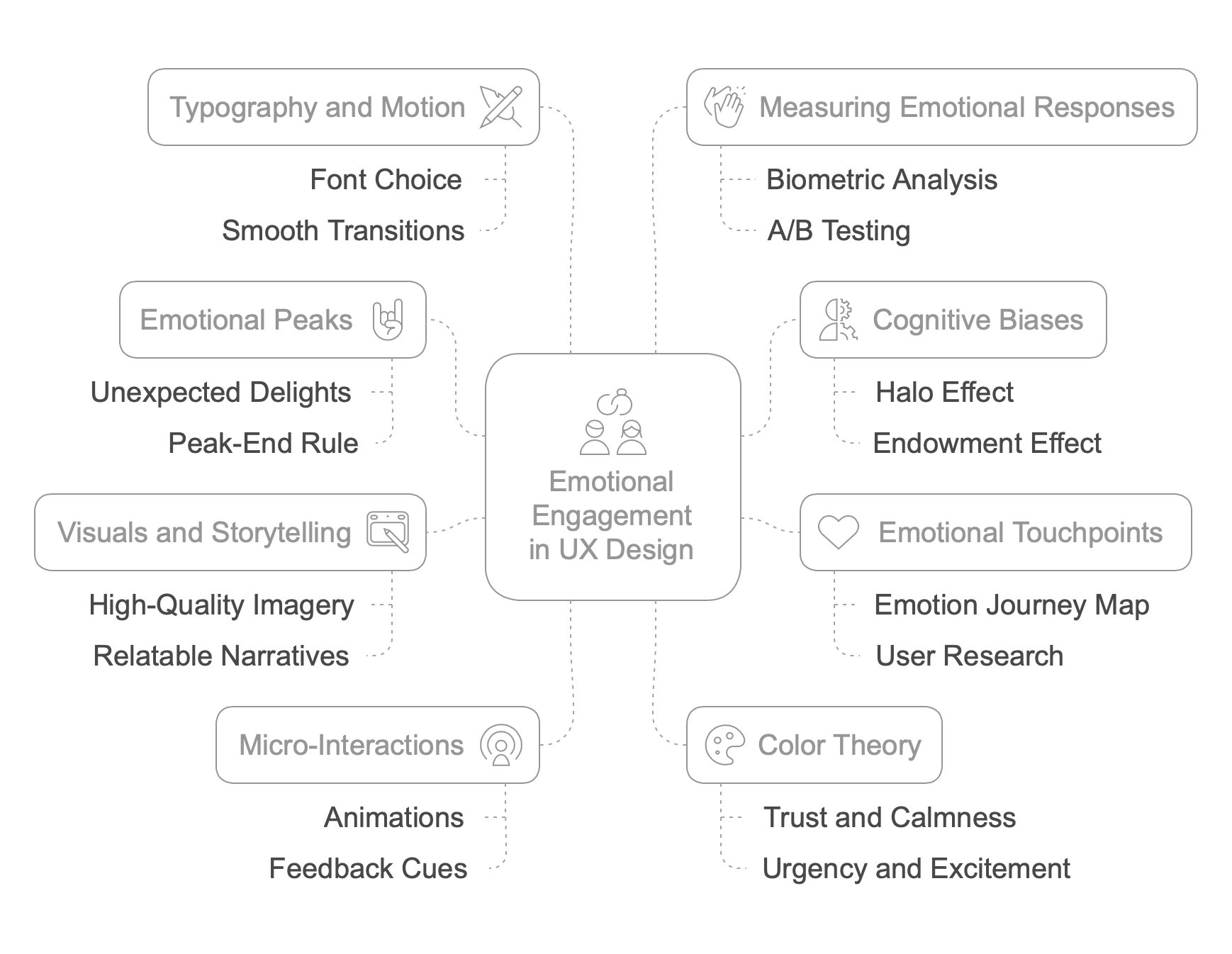
Visuals and storytelling are powerful tools in UX design for triggering emotional responses. High-quality imagery, vibrant colours, and evocative illustrations captivate users and set the emotional tone of a website. Storytelling adds depth by creating relatable narratives, connecting users to the brand on a personal level. For example, hero banners with compelling taglines or videos narrating a brand’s journey can make an immediate and lasting impact.
To be effective, these elements must align with user expectations and cultural nuances. Tailoring content to specific audience segments enhances emotional resonance, making users feel understood and valued.
The role of micro-interactions in crafting delight
Micro-interactions—subtle, often unnoticed design elements—are key to creating moments of joy and engagement. These include animations, hover effects, and feedback cues, like a loading bar that transforms into a smiley face upon completion. Such details make interactions feel human and rewarding.
Beyond aesthetics, micro-interactions provide functional feedback, ensuring users feel in control. For example, a progress indicator during a multi-step process reduces anxiety and fosters a sense of accomplishment. Thoughtful micro-interactions ensure a balance between practicality and emotional engagement, enriching the overall user experience.
How colour theory impacts user sentiment
Colour is a cornerstone of emotional design, with its ability to evoke specific feelings and set the tone of a digital experience. According to research, colours can significantly influence user behaviour. For instance, blue is often associated with trust and calmness, making it a popular choice for finance and healthcare websites, while red evokes urgency and excitement, frequently used for sales or limited-time offers.
The use of gradients, contrasting palettes, or subtle overlays can create depth and guide users through a page. Designers must also consider cultural variations in colour perception to ensure inclusivity and relevance across diverse audiences.
Typography and motion: subtle yet powerful emotional cues
Typography goes beyond readability; it conveys personality and emotion. Bold and modern fonts exude confidence and innovation, while handwritten or serif fonts can evoke nostalgia or sophistication. Font size, weight, and spacing subtly guide user attention and influence their emotional response.
Motion, when used judiciously, enhances engagement by adding dynamism to the design. Smooth transitions, hover effects, or animated elements direct focus and provide feedback, ensuring a more interactive and delightful experience. For example, a button that gently pulsates invites interaction, creating a connection between design and user intent.
Methods for measuring emotional responses in UX
To optimise emotional engagement, measuring user emotions during interactions is essential. Techniques like biometric analysis, eye-tracking, and facial emotion recognition provide objective insights into user responses. For example, eye-tracking reveals which elements draw attention, while biometric sensors monitor heart rate and skin conductivity to detect emotional arousal.
Surveys and tools like the Net Promoter Score (NPS) and Emotional Valence questionnaires offer subjective insights. Paired with analytics such as click-through rates and session durations, these methods form a comprehensive view of how design elements evoke emotions.
A/B testing and heatmaps as tools for emotional design evaluation
A/B testing allows designers to compare two design variations and identify which evokes stronger emotional responses or achieves desired outcomes, such as higher engagement or conversions. For example, testing different colour schemes or call-to-action placements can reveal user preferences and emotional triggers.
Heatmaps complement this by visualising user interactions, highlighting areas of high engagement or neglect.
Future trends in emotional design
Artificial intelligence (AI) is revolutionising emotional design by enabling hyper-personalised experiences. Machine learning algorithms analyse user data, such as preferences, browsing history, and behaviour patterns, to tailor interactions in real time. For example, AI-driven chatbots can adapt their tone and suggestions based on the user’s emotional state, detected through sentiment analysis.
Moreover, dynamic content powered by AI allows websites to evolve with user needs, presenting emotionally resonant visuals, personalised recommendations, or customised calls-to-action. This approach strengthens user engagement by making interactions feel more human and relevant.
Emerging technologies shaping emotional interactions
Technologies like augmented reality (AR) and virtual reality (VR) are transforming how users experience digital environments. AR can create immersive interactions by integrating digital elements into real-world contexts, evoking awe and curiosity. For example, try-before-you-buy features in retail use AR to simulate products, fostering excitement and confidence in purchasing decisions.
Similarly, VR enables fully immersive environments, ideal for storytelling and emotional engagement. Brands can use VR to craft experiences that leave lasting impressions, such as virtual tours or emotionally charged narratives. As these technologies mature, they will redefine the boundaries of emotional UX design.
Emotional peaks in UX design are not merely enhancements but essential components that determine how users connect with digital experiences. The evolving role of technology, including AI, AR, and VR, ensures that emotional design will continue to be a dynamic field, pushing the boundaries of user engagement.
In a digital landscape where attention spans are fleeting, creating emotional highs can mean the difference between a forgettable interaction and a loyal user.
FAQs
What is the role of emotional peaks in UX design?
Emotional peaks enhance user engagement by creating memorable moments during interactions, encouraging retention and fostering positive associations with the brand.
How do colours influence emotional engagement in web design?
Colours evoke specific emotions—such as trust with blue or urgency with red—and influence user behaviour and perception of a brand’s credibility and tone.
Why is A/B testing important in emotional UX design?
A/B testing evaluates design variations to determine which elements evoke stronger emotional responses, helping optimise user experience for better engagement.
What future technologies will shape emotional UX design?
AI, AR, and VR are key technologies driving personalisation, immersion, and dynamic user interactions, significantly enhancing emotional connections in digital experiences.