

SEO
SEO content systems for agencies competing on expertise
Agencies that win on expertise need repeatable, measurable content systems — not ad hoc blogging. This guide explains how to design an SEO content system that scales topical authority, protects quality, and generates leads for high-value services.
IndexOpen×
- 01Why agencies must treat SEO as a system, not a campaign
- 02What a purpose-built SEO content system looks like
- 03Core components of an agency SEO content system
- 04How to build topical authority without burning expert time
- 05Integrating AI without compromising authority
- 06Measuring what matters: leads, influence, and content ROI
- 07Internal linking and topical hub design
- 08Common pitfalls and how to avoid them
- 09Tech stack choices that scale
- 10Governance: keep quality consistent as you scale
- 11From system to business: converting topical authority into leads
- 12Practical first steps for busy agency leaders
- 13Conclusion
Why agencies must treat SEO as a system, not a campaign
Agencies that compete on expertise — niche consultancies, sector specialists, technical service providers — rely on trust. SEO can be the most reliable channel for building that trust at scale, but only if you treat content creation as a system instead of a series of one-off articles.
A content system turns knowledge into a predictable pipeline of discoverable assets: topic clusters, pillar pages, supporting evidence, and distribution hooks that feed demand. It uncouples output from individual skill and ties it to repeatable processes, roles, and tooling. For marketing leaders at agencies, that’s how you move from sporadic visibility to topical authority.
What a purpose-built SEO content system looks like
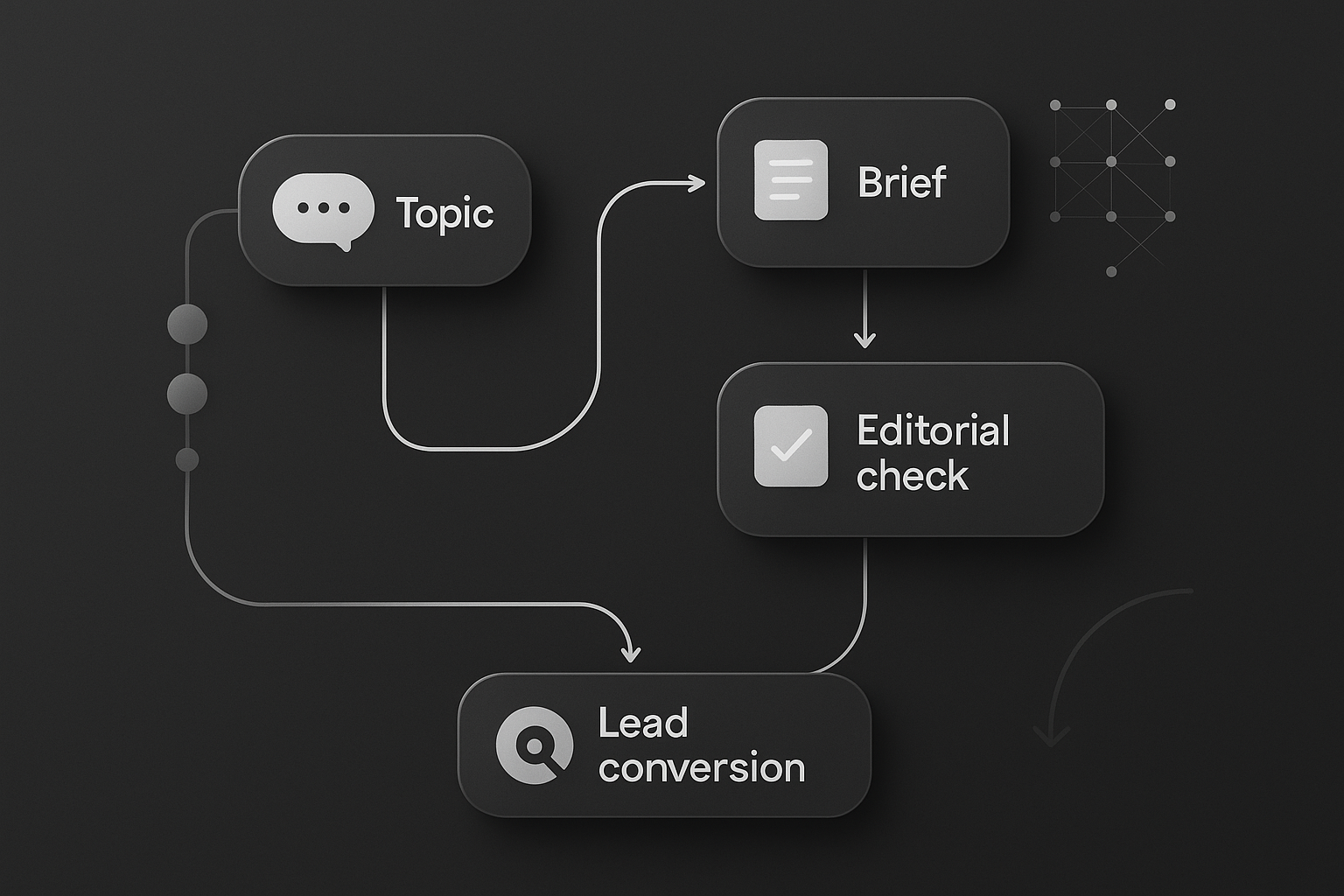
At its core an SEO content system combines three layers: strategy, production, and governance. Each layer has clear inputs and outputs, and together they form a loop that improves with data.
Strategy
Strategy defines what you publish and why. For expertise-driven agencies the emphasis is on topical depth and buyer intent: which subtopics demonstrate your unique methodology, solve revenue-significant client problems, and map to service pages.
Strategy outputs include a topic map, pillar pages, and a prioritised editorial roadmap aligned to commercial stages (awareness, evaluation, decision).
Production
Production is the engine: briefs, research, experts, writers, editors, and an editorial calendar. Production standardises formats so domain experts can contribute efficiently, while ensuring content is optimised for search and conversion.
Governance
Governance enforces quality and keeps the system healthy. It covers content scoring, editorial gates, versioning, internal linking standards, and maintenance schedules. Governance prevents technical debt — stale pages, broken links, and duplicate coverage that dilute authority.
Core components of an agency SEO content system
- Topic taxonomy and semantic modelling: a machine- and human-readable map of your fields of expertise, broken into pillar topics and clusters.
- Brief templates that combine SEO intent with expert inputs, example citations, and conversion objectives.
- A content scorecard that tracks topical coverage, search potential, readability, and trust signals (case studies, methodology, citations).
- Internal linking rules and canonical strategy to funnel authority to service pages and offers.
- Reporting that ties content to qualified leads, not just traffic metrics.
These components make the system repeatable: a content brief plus a content scorecard should enable a subject-matter expert and a trained writer to produce publishable work reliably.
How to build topical authority without burning expert time
Expert interviews and original research are indispensable for credibility, but they’re expensive. The system must be designed so expert time is used where it moves the needle.
Structure interviews into reusable assets: a recorded 20–30 minute session can feed a long-form pillar, two blog posts, a slide deck, and social snippets. Combine those primary inputs with data-led amplification: structured FAQs, schema, comparison tables and annotated source lists that both help search engines and support readers.
Use templates for different formats: ‘methodology deep dive’, ‘client problem + outcome’, ‘how-to with checks and caveats’. Templates reduce cognitive load for contributors and standardise the trust signals that matter for expertise positioning (process diagrams, evidence boxes, time-to-value metrics).
Integrating AI without compromising authority
AI is a catalyst for speed, not a substitute for expertise. The right approach is hybrid: use generative tools for research synthesis, outlining, and drafting boilerplate, then require expert validation and editorial enrichment.
Practical steps:
- Use AI to produce initial outlines and identify related questions from search data.
- Automate internal linking suggestions and metadata drafts, but keep human review mandatory.
- Apply an editorial pass focused on evidence, nuance, and original commentary.
This preserves speed while ensuring the final asset carries the agency’s voice and unique insights.
Measuring what matters: leads, influence, and content ROI
Traffic is a vanity metric unless it converts to conversations. For agencies competing on expertise, measure content by the quality of interactions it produces:
Assisted conversions and the number of enquiries tied to content-driven sessions. Time-on-page for pillar content combined with event tracking (e.g., downloads, demo requests, contact clicks). SERP features captured for branded methodologies and framework searches. Link acquisition from industry sites and citations in third-party content — proxies for external validation.
Use lead tagging and CRM attribution to link content consumption to pipeline stages. That’s how the C-suite understands the ROI of topical authority.
Internal linking and topical hub design
A pragmatic hub-and-spoke structure works best: short, well-optimised service pages sit at the commercial end; supported by deep pillar pages that demonstrate approach and expertise; and clustered posts that address specific queries and funnel internal links back to pillar content and services.
Set rules for anchor text and update cadences. For example: every new cluster post must include at least two contextual links to the relevant pillar and one to a service page. That rule enforces topical coherence and helps search engines understand hierarchical importance.
Common pitfalls and how to avoid them
Producing content without a mapped buyer journey — results in visibility without pipeline. Prioritise content that aligns with commercial intent. Over-reliance on AI drafts without expert review — leads to hollow content that damages credibility. No maintenance plan — content decays; schedule audits every 6–12 months. Fragmented ownership — editorial, SEO and practice leads must share KPIs.
Address these by codifying responsibilities (who owns briefs, who signs off on final drafts), and by creating a content retirement and refresh policy.
Tech stack choices that scale
You don’t need a monolith. Choose tools that reduce friction and integrate with your workflow: a CMS that supports structured content, a content brief and scoring tool, an SEO platform for keyword and SERP tracking, and your CRM for lead attribution. Automate routine checks — broken links, schema errors, redirects — so your team focuses on ideas, not housekeeping.
Governance: keep quality consistent as you scale
Create quality gates: research validation, SEO optimisation, legal/compliance check (if needed), and a final editorial sign-off. Maintain a lightweight but enforced scorecard that rates content on evidence, clarity, novelty, and conversion potential. Only publish when a minimum score is met.
Document style, tone and the agency’s evidence standards so new contributors can onboard quickly. That’s the difference between an agency that occasionally publishes an expert piece and one that sustains a reputation for thought leadership.
From system to business: converting topical authority into leads
Topical authority attracts attention; conversion mechanics turn that attention into pipeline. Use lead magnets that demonstrate capability (audit templates, methodology one-pagers, outcome case studies) and gate higher-value assets behind a low-friction contact step. Ensure forms route directly into a qualified nurture stream tailored to service line and prospect profile.
Quantify impact by tracking content-influenced opportunities. Prioritise experiments that improve conversion rates at the top of the funnel — better lead magnets, clearer next steps on pillar pages, and contextual CTAs embedded in cluster posts.
Practical first steps for busy agency leaders
Start small and measure. Run a three-month experiment around one pillar topic that matters to your most valuable prospects. Build a topic map, create three cluster posts and a pillar page, and instrument lead attribution. Use the results to refine your templates and cadence.
If you’d like help designing a lead-generating SEO content system tailored to your agency’s expertise and sales process, speak with Dool. We design systems that turn knowledge into measurable pipeline without overburdening your experts.
Conclusion
Agencies competing on expertise can’t afford scattershot content. A systematised approach — combining a clear topic taxonomy, standardised production, strong governance and measured outcomes — turns your domain knowledge into sustainable visibility and predictable leads. Build the system deliberately, measure for business impact, and iterate based on what converts.